Soutaipasu is a Japanese term written as 相対パス that means “relative path.” It is a core concept in programming and web development used to locate files based on the current position rather than a fixed full address. Over time, the idea behind soutaipasu has grown beyond technology and now represents flexibility, perspective, and context-based thinking in modern life.
Introduction
Some words look technical at first but carry a much deeper meaning when you look closer. Soutaipasu is exactly that kind of word.
When most people hear it, they assume it belongs only to programmers or tech professionals. But once you understand what it really means, you start to see this concept everywhere — in how you give directions, how you make decisions, and even how you connect with others.
READ MORE: Messagenal: The Complete Guide to Intentional, Purpose-Driven Communication in 2026
This guide explains soutaipasu clearly and completely. You will learn where it comes from, what it means in different areas, and why understanding it can actually improve the way you think and work.
What Is Soutaipasu?
Soutaipasu is built from two Japanese words:
- Soutai (相対) — means relative or comparative
- Pasu (パス) — borrowed from the English word “path”
Together, they form soutaipasu, which directly translates to relative path.
Simple Definition
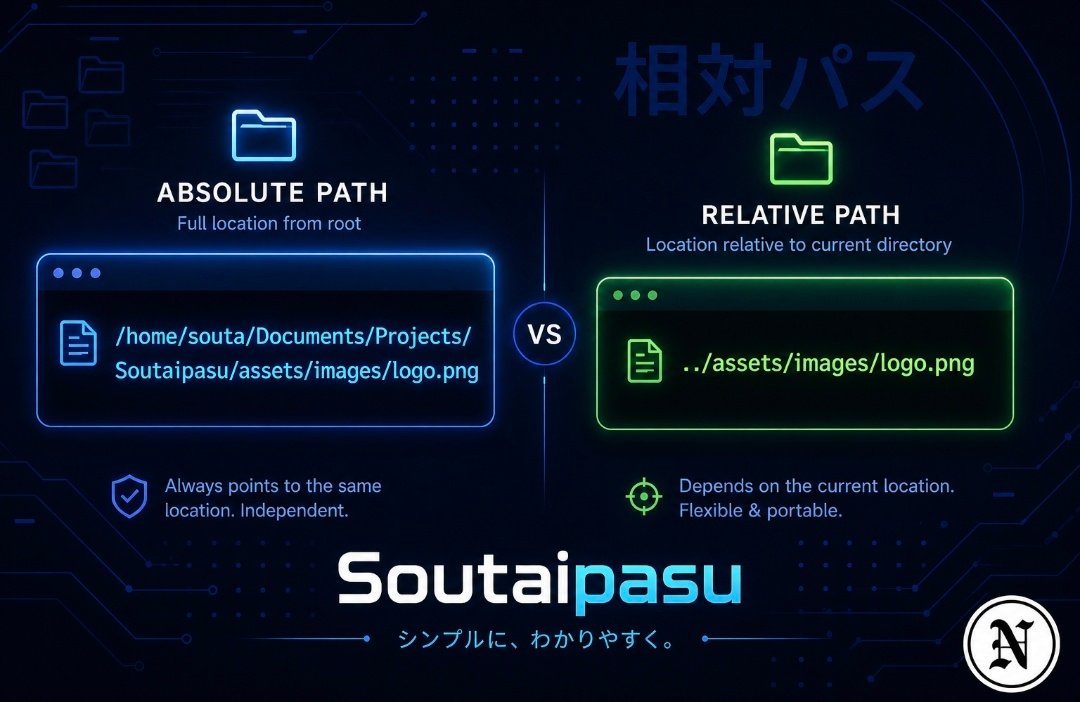
A relative path tells you where something is located based on where you currently are, not based on a complete fixed address from the very beginning of the system.
Quick Comparison Table
| Type | Example | Explanation |
|---|---|---|
| Absolute Path | /home/user/documents/photo.jpg | Full address from root |
| Relative Path (Soutaipasu) | ../photo.jpg | Location based on current folder |
This simple difference makes systems far more flexible and easier to maintain.
The Core Idea Behind Soutaipasu
The single most important idea in soutaipasu is this:
Your starting point determines your direction.
Instead of always describing the full picture, soutaipasu works from where you already are. This saves time, reduces complexity, and keeps everything connected in a logical way.
You already use this thinking in everyday life without realizing it:
- “The pharmacy is two doors after the bakery”
- “Turn left when you reach the old school”
- “It is just past where we met last time”
None of these give a full GPS address. All of them use a starting point to give direction. That is soutaipasu in real life.
Soutaipasu in Programming and Web Development
In the world of coding, soutaipasu has a very practical and important role.
Where Developers Use It
Relative paths appear in almost every kind of project:
- HTML pages linking to images or stylesheets
- CSS files referencing fonts or background images
- JavaScript code importing modules or files
- Python scripts opening data files
- Folder and file navigation in operating systems
Why Developers Prefer Soutaipasu
| Benefit | What It Means in Practice |
|---|---|
| Portability | Project works on any computer without changes |
| Cleaner code | Shorter paths are easier to read |
| Team-friendly | Everyone shares the same folder structure |
| Easy to update | Moving files does not break everything |
| Saves time | No need to rewrite paths for each environment |
Because of these advantages, experienced developers almost always choose relative paths when building websites, apps, and collaborative software projects.
Soutaipasu vs. Zettaipasu: Key Differences
To fully understand soutaipasu, it helps to compare it with its opposite — zettaipasu (絶対パス), which means absolute path.
| Feature | Soutaipasu (Relative) | Zettaipasu (Absolute) |
|---|---|---|
| Starting point | Current location | Root of the system |
| Path length | Short | Long |
| Flexibility | High — adapts to movement | Low — breaks if moved |
| Best for | Web projects, team work | System scripts, fixed locations |
| Risk | Can fail if wrong folder | Can fail if moved to new machine |
Think of it this way. An absolute path is like saying “my house is at 47 Green Street, Springfield, United States.” A relative path is like saying “second house on the left from here.” Both work. But one is much simpler when you already know where you are.
Real-World Examples of Soutaipasu Thinking
The concept of soutaipasu is not limited to programming. You can find it everywhere.
Example 1: Website Development
A developer builds a website on their laptop. All image files sit in an “images” folder next to the HTML files. They write:
../images/logo.pngWhen the website moves to a live server, this relative path still works because the folder structure stays the same. An absolute path would break immediately.
Example 2: Giving Directions
Someone asks where the nearest cafe is. Instead of giving GPS coordinates, you say “walk past the post office, it is on your right.” This works because you both share the same starting point. That is soutaipasu.
Example 3: Personal Decision Making
When you make a decision, you do not start from zero every time. You start from your current situation — your resources, your relationships, your location. Your choices are relative to where you are right now, not some ideal fixed point. That is soutaipasu thinking in real life.
The Cultural Meaning of Soutaipasu
Japan has a long tradition of finding philosophical depth in practical ideas. Soutaipasu follows this tradition.
Why It Fits Japanese Communication
In Japanese language and culture, meaning often depends heavily on context. Words shift in weight and tone depending on who is speaking, who is listening, and what the situation is. Direct fixed statements are less common than in many Western languages.
Soutaipasu reflects this naturally:
- Nothing exists in isolation
- Meaning shifts based on relationship
- Context matters more than fixed definitions
Key Values Soutaipasu Represents
- Flexibility — adapting based on current reality
- Connection — understanding how things relate to each other
- Perspective — seeing that your view depends on where you stand
- Humility — recognizing that there is no single fixed truth for every situation
Different Ways People Use Soutaipasu
Because the concept is flexible by nature, soutaipasu shows up in different ways depending on who is using it.
1. Technical Use
The most direct use — relative paths in code, websites, file systems, and apps.
2. Philosophical Use
A way of thinking about decisions, relationships, and understanding — always from your current position.
3. Creative and Cultural Use
In Japanese online communities, anime discussions, and fanfiction platforms, soutaipasu describes stories or characters whose meaning only makes sense in relation to another — alternate timelines, “what if” scenarios, and branching narratives.
4. Educational Use
In Japan, teachers use the soutaipasu concept to explain relational thinking — how ideas connect to each other rather than standing alone as isolated facts.
Why Soutaipasu Is Growing in Popularity
This word has been appearing more often in tech blogs, creative writing, and online discussions. There are clear reasons for this trend.
Coding Is Everywhere Now
As more people learn programming — from students to professionals to hobbyists — technical vocabulary like soutaipasu travels into general conversation.
The Internet Crosses Borders
Japanese technical terms reach global audiences through translated tutorials, YouTube videos, coding bootcamps, and developer forums. Words that once stayed inside Japan now spread worldwide.
People Want Ideas That Explain Both Logic and Life
Soutaipasu is rare because it works on two levels at once. It is practical in technology and meaningful in daily thinking. That combination attracts attention.
Creative Communities Adopted It
Writers, game designers, and storytellers picked up soutaipasu as a metaphor for branching choices and alternate perspectives. This gave the word a second life outside of tech.
Common Mistakes When Using Soutaipasu in Code
Even experienced developers make errors with relative paths. Knowing these in advance saves hours of debugging.
Mistake 1: Not Knowing Your Current Directory
The most common problem. The relative path resolves from wherever your script or file is currently running — not from wherever you think it is. Always confirm your working directory first.
Mistake 2: Mixing Slash Types
Windows systems use backslashes () while web browsers and most programming languages use forward slashes (/). Mixing them in the same project causes hidden errors that are hard to find.
Mistake 3: Too Many ../ Levels
Writing something like ../../../data/file.txt means your folder structure needs rethinking. Deep path navigation creates fragile code. Restructure your folders instead.
Mistake 4: Mixing Relative and Absolute Paths
Switching between both styles in the same project without a clear plan creates confusion. Pick one approach and stay consistent throughout.
How to Apply Soutaipasu Thinking in Everyday Life
You do not need to write a single line of code to benefit from this concept.
Practical Ways to Use It
- Start from where you are, not where you wish you were. Make decisions based on your real current situation, not an idealized starting point.
- Give context when communicating. Explain your reasoning from a shared reference point so others can follow your thinking.
- Stay flexible. Fixed absolute thinking breaks down when circumstances change. Relative thinking adapts.
- Understand relationships. Before judging something, consider what it is relative to — what came before it, what surrounds it, what connects to it.
These are not just good habits. They are the core philosophy behind soutaipasu.
The Future of Soutaipasu
As technology continues to expand into every part of life, terms like soutaipasu will only become more relevant.
In programming, relative paths will remain a foundational skill for every developer working with files, websites, and collaborative projects. In culture, the concept will keep growing as people look for ways to describe flexible, context-driven thinking.
The interesting thing about soutaipasu is that its own meaning follows its own definition. What soutaipasu means to you depends on where you are standing when you encounter it. A developer sees a technical tool. A philosopher sees a life principle. A storyteller sees a narrative device.
All of them are right. Because meaning depends on context.
READ MORE: Tech Hacks PBLinuxGaming: The Complete 2026 Guide to Dominating Linux Gaming Performance
Final Thoughts
Soutaipasu began as a precise technical term inside Japanese programming documentation. Today it represents something much wider — a way of understanding how location, context, and relationships shape meaning.
Whether you use it in your code or just carry the idea in your thinking, soutaipasu teaches one honest truth:
Where you are right now is always your real starting point.
Work from there. Stay flexible. Understand that nothing exists in isolation. That is the full lesson of soutaipasu, and it applies whether you are debugging a website or navigating life.
Frequently Asked Questions
What does soutaipasu mean in English?
Soutaipasu means “relative path.” It describes a file or resource location based on the current working directory rather than a complete fixed address from the system root.
Is soutaipasu only used in Japan?
The word is Japanese, but the concept of relative paths is used by developers worldwide in every programming language and operating system.
How is soutaipasu different from absolute path?
A relative path (soutaipasu) changes based on your current location. An absolute path stays the same no matter where you are. Relative paths are shorter and more flexible, while absolute paths are fixed and precise.
Can beginners understand soutaipasu easily?
Yes. The core idea is simple — give directions based on where you are now, not from a fixed starting point. Once that idea clicks, the technical application in code follows naturally.
Why does soutaipasu sometimes cause errors in coding?
Errors happen when the developer assumes a wrong current directory, mixes slash types between operating systems, or navigates too many folder levels up with ../. These are easy to avoid once you understand how relative paths resolve.
Does soutaipasu have a meaning outside of programming?
Yes. It has grown into a broader concept representing context-based thinking, relational understanding, and perspective. Creative communities in Japan use it to describe branching stories and alternate character paths in fiction.
Is soutaipasu taught in schools?
In Japan, it is introduced early in coding education when students learn HTML and CSS. The concept of linking files relatively is one of the first practical skills taught in web development courses.
READ MORE: https://newsobuzz.com/