

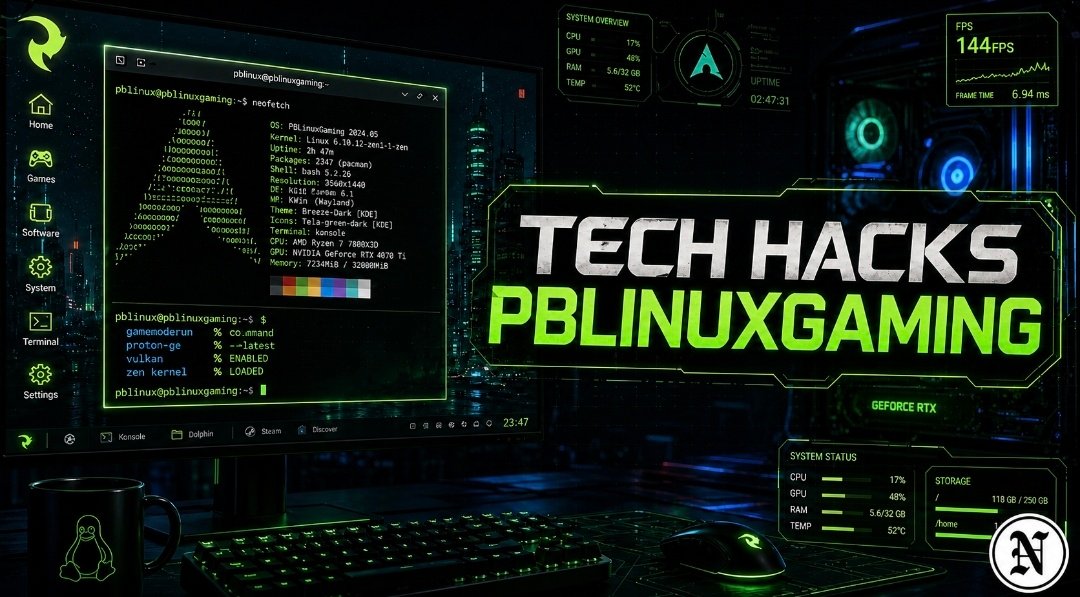
Three years ago, if you told a Windows gamer you were switching to Linux, they’d laugh. “Good luck running anything,” they’d say. Today, that conversation has completely flipped. Linux gaming in 2026 is not just viable — it’s genuinely competitive. Steam Deck proved it to millions. But here’s what nobody tells you: out-of-the-box Linux gaming still leaves serious performance on the table.
That’s exactly where Tech Hacks PBLinuxGaming comes in.
Tech Hacks PBLinuxGaming refers to a community-based approach to optimizing Linux gaming performance — not a single application or official product, but a set of practical methods, tweaks, and configurations shared by Linux gaming enthusiasts to improve performance, fix issues, and make Windows games run more smoothly on Linux.
This guide gives you everything: from beginner-level driver fixes to advanced kernel tuning that competitive players use to squeeze every last frame out of their hardware. I’ll be honest about what works, what’s overhyped, and what the community often gets wrong.
What Exactly Is PBLinuxGaming? (The Real Answer)
Most articles dance around this. Let me be direct.
Tech Hacks PBLinuxGaming has recently appeared across blogs and forums as a phrase linked to improving gaming performance on Linux. While it is not an official software or a recognized platform, the idea behind it reflects something very real: a collection of practical tweaks, tools, and techniques that help Linux users run modern games more smoothly.
READ MORE: Renvoit.com: Complete Guide 2026 – What It Is, How It Works & Is It Safe?
Think of it less like a product and more like a living playbook — one that the Linux gaming community keeps updating as tools evolve.
Tech Hacks PBLinuxGaming is not about cheating in games or using unfair tricks. It is about improving your Linux gaming setup through smart system changes, better software choices, driver updates, and performance-friendly settings. For beginners, it can mean learning how to install the right game launcher. For advanced users, it may include kernel tuning, Vulkan setup, or custom performance profiles.
The beauty of this approach? You don’t have to apply every hack at once. You pick what your system needs, test it, and move forward. That’s exactly how I recommend approaching it.
Choosing the Right Linux Distro: Your Foundation Matters More Than Any Hack
Before you touch a single config file, you need the right base. This is the mistake most beginners make — they try to optimize a distro that was never built for gaming.
A strong gaming experience begins with choosing the right Linux distribution. Ubuntu, Pop!_OS, Fedora, Linux Mint, and Manjaro are common choices because they have active communities, regular updates, and good driver support. Pop!_OS is often liked by NVIDIA users because of its easier graphics driver handling, while Manjaro and Arch-based systems attract users who want newer software packages.
My honest take after testing several of these: Nobara Linux (built by GloriousEggroll, the same person behind Proton GE) is currently the strongest out-of-box gaming distro in 2026. It ships with gaming-focused kernel patches and pre-configured multimedia codecs that save you hours of setup time.
For beginners, Pop!_OS (System76) and Nobara Linux (GloriousEggroll) offer the best out-of-box gaming experience.
If you’re on Arch or Manjaro, you get access to the AUR (Arch User Repository), which means cutting-edge versions of every gaming tool almost immediately after release. The trade-off is a steeper learning curve and occasional breakage after updates. Experienced users will love it. Absolute beginners should start with Pop!_OS.
GPU Drivers: The Single Biggest Performance Variable
I cannot stress this enough. Before any other optimization, your GPU drivers must be current and properly installed. This single step accounts for the majority of performance gains that new Linux gamers experience.
Whether you are using NVIDIA, AMD, or Intel graphics, updated drivers bring significant improvements. On Linux, you should always use official drivers from trusted repositories or vendor tools. NVIDIA users should install proprietary drivers for best gaming performance. AMD users should use Mesa drivers, which are already well optimized in Linux.
Here’s something the guides don’t emphasize enough: NVIDIA and AMD have very different driver situations on Linux, and your hardware choice genuinely affects your experience.
NVIDIA users: You need the proprietary driver. The open-source Nouveau driver is not suitable for gaming — full stop. Install the nvidia-dkms package on Arch-based systems or use the built-in driver manager on Pop!_OS. Avoid mixing driver versions.
AMD users: You’re in a better position. Mesa drivers are open-source and built directly into most modern Linux distributions, providing solid Vulkan support without requiring separate proprietary driver installation. The RADV (Mesa Vulkan driver) is excellent and actively developed by AMD engineers themselves.
After a proper driver update, many players report 20-40% FPS improvements in games that were previously stuttering. That’s not a hack — that’s just fixing what should have worked from the start.
Steam Proton and Proton GE: The Compatibility Revolution
Running DirectX games on Linux requires translation to Vulkan, which can introduce performance overhead. Proton is a compatibility tool developed by Valve that allows Windows games to run on Linux through Steam. Wine is a compatibility layer that translates Windows system calls into Linux-compatible instructions. These tools convert DirectX graphics calls into Vulkan, enabling better performance in many games.
Stock Proton is impressive. But the community has taken it further.
Proton GE (Glorious Eggroll) is a community-maintained fork of Proton that includes patches not yet merged into Valve’s official version. Switching to Proton GE can sometimes fix broken games instantly, and for many titles delivers noticeably better performance than the default Proton release.
How to use Proton GE correctly:
- Install ProtonUp-Qt from your package manager or Flathub — it gives you a simple GUI to manage Proton versions
- Download the latest Proton GE release through ProtonUp-Qt
- In Steam, right-click any game → Properties → Compatibility → Force use of specific Steam Play compatibility tool → Select Proton GE
- Always check ProtonDB (protondb.com) before launching a new game — real users report which Proton version works best for each title
One thing I’ve learned: don’t always use the absolute latest Proton GE. Sometimes a game runs better on a version from two releases ago. ProtonDB user reports tell you exactly which version works best for your specific title.
GameMode: The Quiet Performer That Most People Ignore
GameMode is a useful tool developed by Feral Interactive that helps Linux focus system resources while a game is running. It can adjust CPU behavior, reduce background interference, and help games feel smoother. It is especially helpful on systems where background processes affect frame timing or create small stutters.
GameMode works by temporarily changing your CPU governor to “performance” mode, pausing certain background processes, and applying I/O priority adjustments — all while you’re gaming, and reverting everything when you quit.
Installation is simple on most distros:
sudo apt install gamemode        # Ubuntu/Debian
sudo pacman -S gamemode          # Arch/Manjaro
To use it with Steam, add this launch option to any game:
gamemoderun %command%Combining GameMode with Proton GE and CPU performance mode delivers the best results during testing. It’s not a one-click fix, but it works extremely well.
The benefit here is stability. Rather than making risky permanent system changes, GameMode gives your game better priority while keeping the rest of your system intact.
Vulkan and DXVK: Understanding the Graphics Translation Layer
This is where things get technically interesting — and where most guides give you half the story.
DXVK converts DirectX graphics calls into Vulkan. This often leads to better performance, especially on modern hardware. Within the context of Tech Hacks PBLinuxGaming, these tools are not optional — they are foundational.
Vulkan itself is the key. Vulkan-based rendering has changed the Linux gaming landscape. By reducing overhead and improving efficiency, it allows games to run closer to native performance levels. This is especially noticeable in titles that heavily rely on DirectX when played through compatibility layers.
A practical tweak many players miss: shader pre-compilation. The first time you run a game through Proton, it compiles shaders on-the-fly, causing the infamous “shader stutter” during gameplay. Enabling shader pre-compilation in Steam settings makes gameplay smoother after the initial load, as the compilation happens before you play rather than during.
Enable this in Steam → Settings → Shader Pre-Caching → turn on both options.
CPU Governor and Kernel Tweaks: The Intermediate Level
Once you’ve handled drivers, Proton, and GameMode, you’re ready for the next layer.
One common tweak involves adjusting the CPU governor. By switching to performance mode, the processor runs at higher speeds consistently, reducing frame drops during intense gameplay. These system-level adjustments are a major part of what people refer to when discussing Tech Hacks PBLinuxGaming.
Set your CPU governor manually:
echo performance | sudo tee /sys/devices/system/cpu/cpu*/cpufreq/scaling_governorNote: this resets on reboot. For a permanent solution, use cpupower or tuned with a gaming profile.
Gaming Kernels take this further. PBLinuxGaming Tech Hacks include gaming kernels like Zen, Liquorix, and XanMod, which provide better CPU scheduling and lower latency compared to the standard Linux kernel.
The Zen kernel (available on Arch via linux-zen) is the community favorite. It applies scheduling tweaks that prioritize interactive tasks — exactly what gaming needs. On Nobara Linux, a gaming-tuned kernel ships by default.
The performance difference is real but subtle. Expect 5-15% improvement in CPU-bound scenarios, more consistent frame pacing, and reduced input latency. Not magical, but measurable.
MangoHud: Monitor Everything, Guess Nothing
You can’t optimize what you can’t measure. MangoHud is the performance overlay that serious Linux gamers use to understand exactly what their system is doing.
MangoHud provides real-time monitoring of FPS, CPU usage, GPU temperature, VRAM usage, and frame timing — giving gamers the data they need to verify that their optimizations are actually working.
Install it, then add mangohud %command% to your Steam launch options (combine with gamemoderun: mangohud gamemoderun %command%).
What to watch for:
- Frame time spikes indicate stuttering sources — often background processes or shader compilation
- GPU usage under 95% means something else is bottlenecking you — usually CPU or RAM
- VRAM near limit means you need to reduce texture quality settings
MangoHud turns optimization from guesswork into science. Use it every time you make a change.
Lutris and Non-Steam Games: Beyond the Steam Ecosystem
Not every game is on Steam. Lutris is a powerful game manager that helps Linux gamers run GOG games, Epic Games titles, older Windows games, and emulators. It also allows custom Wine configurations and scripts, making it extremely useful for advanced Linux gamers.
Lutris maintains a database of community-tested install scripts for hundreds of games. Before manually configuring Wine for a non-Steam game, check the Lutris website — someone has almost certainly already figured out the right configuration.
For Epic Games titles specifically, Heroic Games Launcher has become the community standard. It’s cleaner than Lutris for Epic-specific needs and supports GOG as well.
Network Optimization for Online Gaming
For multiplayer gaming, latency matters more than FPS. Linux network tuning can significantly reduce ping and improve connection stability.
Two practical tweaks:
Enable BBR congestion control:
echo "net.core.default_qdisc=fq" | sudo tee -a /etc/sysctl.conf
echo "net.ipv4.tcp_congestion_control=bbr" | sudo tee -a /etc/sysctl.conf
sudo sysctl -p
This Google-developed algorithm improves throughput and reduces bufferbloat — a common cause of inconsistent latency in online games.
Reduce swappiness for RAM management:
echo "vm.swappiness=10" | sudo tee -a /etc/sysctl.confLinux uses swap memory when RAM is full, but improper configuration can cause lag. Reducing swappiness helps decrease stuttering during heavy gameplay moments.
The Integrated Approach: Why Layering Matters
Here’s the insight that separates genuinely optimized setups from tweaked ones:
The true power of PBLinuxGaming Tech Hacks emerges when all optimization layers work together as an integrated system. A gaming-optimized kernel provides better CPU scheduling, GameMode locks CPU to maximum frequency, Mesa or NVIDIA drivers deliver optimized GPU communication, Proton and DXVK translate Windows games efficiently, MangoHud verifies everything works, and network tuning ensures online gameplay is responsive. This layered approach is what separates casual Linux gaming from truly optimized performance.
Apply changes incrementally. Test with MangoHud after each change. That way you know exactly what’s helping and what’s doing nothing.
READ MORE: Messagenal: The Complete Guide to Intentional, Purpose-Driven Communication in 2026
Conclusion: Linux Gaming Has Earned Its Place
Linux gaming in 2026 is not a compromise. With the right configuration — solid drivers, Proton GE, GameMode, a gaming kernel, and proper monitoring — you can match Windows performance in most titles and actually exceed it in Vulkan-native games.
With Steam Proton, DXVK, and Vulkan-based translation layers, many games run at 95-105% of Windows performance. Some titles actually perform better on Linux because Vulkan’s lower driver overhead compensates for the translation cost.
The PBLinuxGaming approach works because it’s systematic, not magical. You’re not hoping for a miracle tweak — you’re building a properly configured gaming platform, layer by layer. That’s a philosophy that holds up regardless of how the tools change.
Start with your GPU drivers. Add Proton GE. Enable GameMode. Monitor with MangoHud. Then go deeper if you want to. The community has done the hard work of figuring out what works — your job is to apply it intelligently.
Frequently Asked Questions
Q: Is PBLinuxGaming a legitimate platform or just a marketing term?
It is a label used by the community to describe a combination of performance tweaks and compatibility tools designed for Linux gaming — not an official product or company. The techniques it describes are real and well-documented.
Q: Can Linux actually match Windows gaming performance in 2026?
Yes, in most cases. Many games run at 95-105% of Windows performance with proper Proton and Vulkan configuration. Some Vulkan-native titles actually perform better on Linux due to lower driver overhead.
Q: Which is better for gaming — NVIDIA or AMD on Linux?
AMD currently has a smoother Linux experience due to open-source Mesa drivers that require no separate installation. NVIDIA performs well but requires proprietary driver setup and occasional troubleshooting.
Q: What is the first thing I should do to improve Linux gaming performance?
Before changing advanced settings, update your GPU drivers and system packages. Many performance problems disappear after a proper update because new drivers often include fixes for Vulkan, shader handling, and game compatibility.
Q: Is Proton GE safe to use?
Yes. Proton GE is open-source, widely used, and maintained by a trusted community developer. Changes should be made carefully because not every custom version improves every game — always check ProtonDB for game-specific recommendations.
Q: Do I need a powerful PC to benefit from these optimizations?
No. Many of these tweaks — especially CPU governor settings, GameMode, and Proton version selection — provide meaningful improvements even on mid-range hardware where every frame counts most.
Q: Will anti-cheat systems cause problems on Linux?
Some do. Easy Anti-Cheat and BattlEye both have Linux support enabled by game developers on a per-title basis. Check ProtonDB for your specific game before purchasing if anti-cheat compatibility matters to you.
Q: What is MangoHud and why should I use it?
MangoHud provides real-time monitoring of FPS, CPU usage, GPU temperature, VRAM, and frame timing — it’s the essential tool for verifying that your optimizations are actually working and identifying where bottlenecks remain.
READ MORE: https://newsobuzz.com/
