
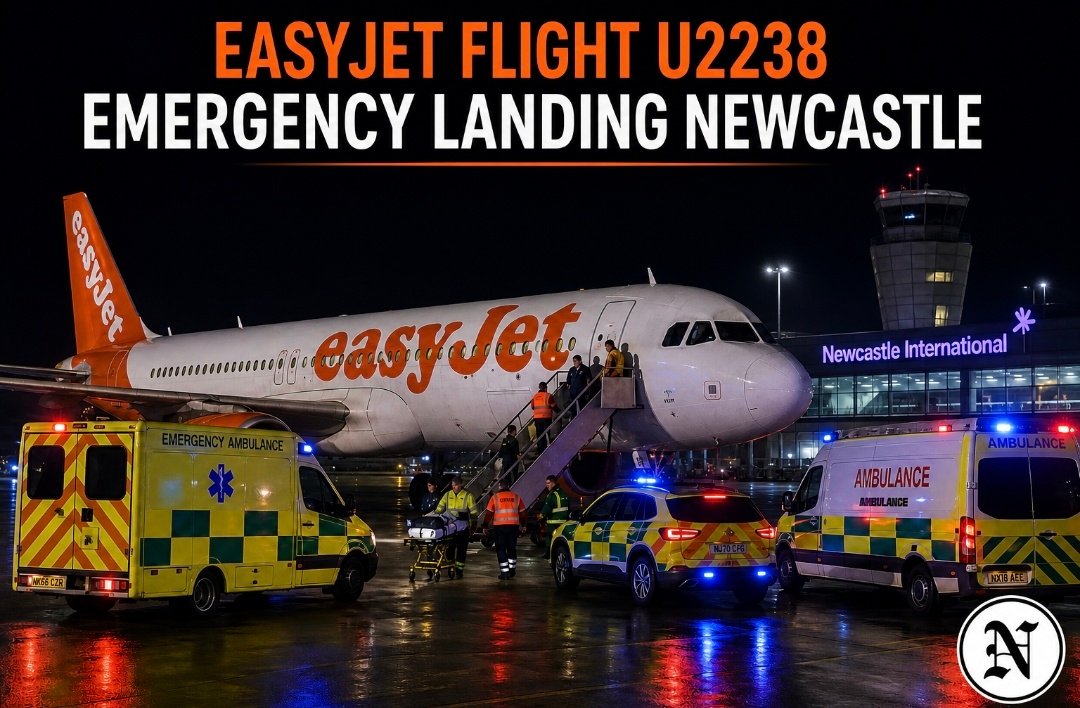
It was just after 10 PM on a Monday night. You had headphones on, settled into seat 23A somewhere over the North Sea, expecting to land in Manchester in under an hour. Then the engines changed pitch. Cabin crew moved faster than they had all flight. The captain’s voice came through the intercom, calm but deliberate, telling you that plans had changed. You were landing in Newcastle.
That is the lived experience of the 178 passengers aboard EasyJet Flight EZY2238 on October 27, 2025. And here is what I think matters most about it: this was not a story about something going wrong. It was a story about aviation doing exactly what it was designed to do.
What Flight Was This, Exactly?
Before we get into the timeline, let’s clear up the naming confusion that has produced a surprising amount of misleading coverage.
EasyJet uses “U2” as its IATA airline code on tickets and schedules. EasyJet also runs a separate Newcastle to Bristol service under the shorter code U2238, and the overlap between the two codes produced factual errors in several published accounts. The emergency on October 27 involved the Copenhagen to Manchester route, operating under the full designation EZY2238.
READ MORE: SEO by highsoftware99.com: The Complete, No-Fluff Guide to Ranking in 2026
So when you see U2238, U22238, EZY2238, or U2 2238 in different articles and flight tracking apps, they are all referring to the same Copenhagen-to-Manchester service. The formatting varies by system. The flight does not.
The Timeline: 15 Minutes That Changed Everything
EZY2238 pushed back from Copenhagen Airport at 22:13 local time, already 28 minutes behind its scheduled 21:45 departure. On board were 178 passengers and six crew members, occupying 178 of the aircraft’s 180 seats.
The aircraft was an Airbus A320-214, registered G-EZPB. Powered by CFM56-5B4/P engines and fitted with Sharklet winglets, G-EZPB had been in continuous easyJet service since its factory delivery on February 18, 2016. At nine years old, it held no reported technical issues before that night.
Around 15 minutes after departure, a passenger fell seriously ill over the North Sea. Cabin crew escalated immediately to the flight deck. At approximately 21:28 UTC, the captain set the aircraft’s transponder to squawk code 7700, the ICAO-designated signal for a general aviation emergency. From that moment, UK Air Traffic Control received automatic notification, other aircraft in the area were redirected, and Newcastle Airport was put on standby to prepare emergency services on the ground.
The plane landed safely at Newcastle Airport shortly before 11 PM local time, where medical teams immediately boarded and transported one passenger to Newcastle’s Royal Victoria Infirmary.
After approximately 70 minutes on the ground, EZY2238 departed Newcastle at 00:02 GMT on October 28 and landed at Manchester Airport at 00:28 GMT, completing the remaining distance in 26 minutes. The aircraft had been on the ground at Newcastle for approximately 70 minutes between touchdown and departure.
The entire diversion, from emergency declaration to resumption of the original journey, took less than two hours. That is what a well-executed aviation emergency looks like.
Why Newcastle? The Decision Behind the Diversion
This is the question most passengers and observers ask first. Why not continue to Manchester? Why not somewhere else?
Here is what people get wrong about diversions: they assume the decision is about finding the “nearest” airport in a straight-line sense. It is not. The actual calculus involves runway length, available emergency services on the ground, air traffic congestion on the approach, proximity to a suitable hospital, and the real-time condition of the patient.
Crews and controllers weigh factors like distance, weather, runway length, available emergency response, and how smoothly the landing and arrival can be managed. Newcastle ticked every box. It is a major regional airport capable of handling Airbus A320 aircraft without issue. North East Ambulance Service paramedics were positioned at the runway before the wheels touched down. And critically, Newcastle’s Royal Victoria Infirmary, a Level 1 trauma centre, was within rapid transfer distance.
The passenger reached a Level 1 trauma centre within roughly an hour of the emergency being declared at 38,000 feet. That speed mattered. Choosing to push on to Manchester, another 30 or 40 minutes of flight time, could have been catastrophic.
The decision was not about convenience. It was about keeping a person alive.
What Is Squawk 7700 and Why Did It Matter?
For anyone unfamiliar with aviation radio procedures, the squawk 7700 declaration deserves a proper explanation.
Every commercial aircraft carries a transponder that broadcasts a four-digit code to air traffic control radar systems. Codes are assigned by controllers during normal operations. But three codes are universal and reserved for emergencies: 7700 for general emergency, 7600 for radio failure, and 7500 for hijacking.
The “squawk 7700” code is a standard distress signal used by pilots to indicate a general emergency, and it was swiftly responded to by UK air traffic control. The moment that code transmits, everything changes. Other aircraft nearby are redirected. The declaring aircraft gets absolute priority. Controllers stop taking routine requests and focus entirely on clearing a path.
In this case, EasyJet flight U2238 was given full priority. Other flights nearby had to slow down or wait. For example, one flight was placed in a holding pattern in the air so the easyJet plane could land first.
That is not an inconvenience. That is the system functioning at its best.
The Crew: What They Were Actually Doing
Here is what most people do not appreciate about a medical emergency at cruising altitude. The cabin crew were managing two completely separate crises simultaneously.
First, they were providing direct medical assistance to an acutely unwell passenger. That means assessing symptoms, administering supplemental oxygen from the onboard emergency kit, potentially using the defibrillator if required, and asking whether any medical professionals among the other passengers could assist. EasyJet, like most major European carriers, trains crew to handle cardiac arrest, severe allergic reactions, diabetic crises, and stroke symptoms.
Second, they were managing the psychological state of 177 other passengers. A cabin that tips into panic makes a medical emergency significantly harder to handle. Some passengers later shared that they felt nervous at first, but seeing how confident the crew was made them feel better. Small things like kind words and regular updates made a big difference.
That balance, clinical response on one side, calm authority on the other, is the product of years of repeated simulation training. It does not happen by accident.
How Often Does This Actually Happen?
One of the persistent myths about aviation is that emergency diversions are rare, dramatic events that signal something deeply wrong with an airline or an aircraft. The data tells a different story.
More than 12,000 diversions occurred in 2024, averaging over 30 daily. Medical emergencies occur on approximately 1 of every 604 commercial flights, with 10 percent resulting in diversions.
Think about that figure for a moment. On any given day, roughly 30 flights worldwide divert from their planned route. Medical situations account for a significant proportion of those. The reason you do not hear about most of them is precisely because they are handled so competently that they never generate headlines.
The EZY2238 diversion attracted attention partly because of the squawk 7700 declaration being picked up by enthusiast flight tracking communities. Platforms like Flightradar24 allow anyone to watch aircraft transponder data in real time, and an emergency code broadcast over the North Sea generates immediate interest. But the underlying event, a crew responding correctly to a passenger medical crisis, happens dozens of times per week across global aviation.
The Aircraft: What Happened to G-EZPB After?
There was understandable speculation in some online forums about whether the aircraft itself had any issues. The answer is no.
Airport engineers carried out mandatory post-incident checks on G-EZPB. No technical faults were found. The diversion was entirely due to the passenger medical emergency, not any issue with the airframe, engines, or systems. This is important to state clearly because some early coverage conflated the emergency code with a mechanical problem. It was not.
G-EZPB returned to easyJet service after engineers cleared it in the early hours of October 28. The aircraft that carried 178 people to safety that night was back in the sky within hours. That is both operationally impressive and, honestly, the most normal possible outcome of a well-managed diversion.
What Happened to the Passenger?
Neither easyJet, NEAS, nor Newcastle Hospitals NHS Foundation Trust disclosed the patient’s identity or the specific medical condition, which is standard confidentiality practice across all NHS emergency admissions.
This is correct and appropriate. Medical privacy does not become negotiable because the illness happened at 38,000 feet and a flight tracking website noticed the squawk code. What is publicly confirmed is that the passenger was transported to the Royal Victoria Infirmary, a facility well equipped for serious emergencies.
Thankfully, there have been no reports of life-threatening outcomes. Beyond that, the details remain private, as they should.
easyJet’s Official Response
easyJet confirmed the diversion in a formal statement: “Flight EZY2238 from Copenhagen to Manchester on 27 October diverted to Newcastle, due to a customer onboard requiring urgent medical attention.”
Short, accurate, and appropriately discreet. Airlines walk a difficult line when communicating about medical diversions. They need to confirm what happened for transparency and for the passengers who were on board. But they cannot and should not speculate about medical details or publish information that identifies the patient.
What This Means for You as a Traveller
If you have ever sat in a plane and wondered what would happen if someone near you had a medical emergency, the EZY2238 case gives you a clear, documented answer.
The crew will act immediately. The pilots will assess whether to divert. Air traffic control will clear a path within seconds of a squawk 7700 declaration. Ground emergency services will be positioned and waiting before the aircraft lands. And a hospital capable of handling serious emergencies will be reachable within minutes of touchdown.
Travel insurance covers costs from diverted flights, including meals, transportation, and lodging. Airlines provide hotel accommodations when passengers cannot reach final destinations by 11:59 PM. The remaining passengers on EZY2238 reached Manchester before 1 AM. An inconvenient night, but a safe one.
The most reassuring truth about aviation is this: the procedures that protected that critically ill passenger over the North Sea exist on every commercial flight you will ever take. They are practised, tested, and refined continuously. An emergency landing is not a sign of failure. It is proof the system works.
READ MORE: What Is Adstotally.com? A Real Look at the Site and How Multi-Niche Blogs Can Succeed in 2026
Conclusion
The EasyJet Flight U2238 emergency landing at Newcastle on October 27, 2025 was resolved in under two hours. One person received urgent medical care at a Level 1 trauma centre. The other 177 passengers reached Manchester safely. The aircraft was back in service the same night.
That is not a dramatic aviation incident. That is aviation doing exactly what it was built to do.
The crew on G-EZPB that night made every correct decision under real pressure: escalate fast, declare the emergency, divert without hesitation, and keep the cabin calm. Air traffic control cleared the skies. North East Ambulance Service had paramedics at the runway before touchdown. Newcastle’s Royal Victoria Infirmary received a patient who arrived in time to receive proper care.
If there is one thing this incident should change, it is the instinct to read “emergency landing” as a synonym for disaster. In commercial aviation, an emergency landing very often means the opposite: a team of professionals choosing safety over schedule, and getting it right.
Frequently Asked Questions
Why did EasyJet Flight U2238 make an emergency landing at Newcastle?
The flight diverted from its Copenhagen-to-Manchester route because a passenger became critically ill approximately 15 minutes after takeoff. The crew declared a general aviation emergency, and Newcastle was selected as the nearest airport with appropriate emergency response capability and hospital access.
What does squawk 7700 mean?
It is a universal four-digit transponder code that pilots activate to signal a general aviation emergency to all nearby air traffic control facilities. It immediately grants the aircraft full priority routing and alerts ground emergency services.
Were all passengers safe?
Yes. All 178 passengers and six crew members were unharmed. The unwell passenger was transferred to Newcastle’s Royal Victoria Infirmary. The remaining passengers continued to Manchester on the same aircraft approximately 70 minutes later.
Was there a mechanical fault with the aircraft?
No. Post-incident engineering checks on G-EZPB confirmed no technical faults. The diversion was caused entirely by the passenger medical emergency.
How common are medical diversions in commercial aviation?
More common than most people realise. Medical emergencies occur on roughly one in every 604 commercial flights globally, with around 10 percent of those leading to a diversion. Across the industry, this produces dozens of diversions every day.
Will travel insurance cover what happened to the other passengers?
In most cases, yes. Standard travel insurance policies cover costs arising from diverted flights, including overnight accommodation, meals, and onward transportation when passengers cannot reach their destination the same evening.
Why was easyJet vague about the passenger’s condition?
Medical confidentiality rules, both airline policy and NHS practice, prevent the disclosure of patient identities or diagnoses without consent. This applies equally to emergencies that happen on aircraft as to those that happen anywhere else.
READ MORE: https://newsobuzz.com/
