
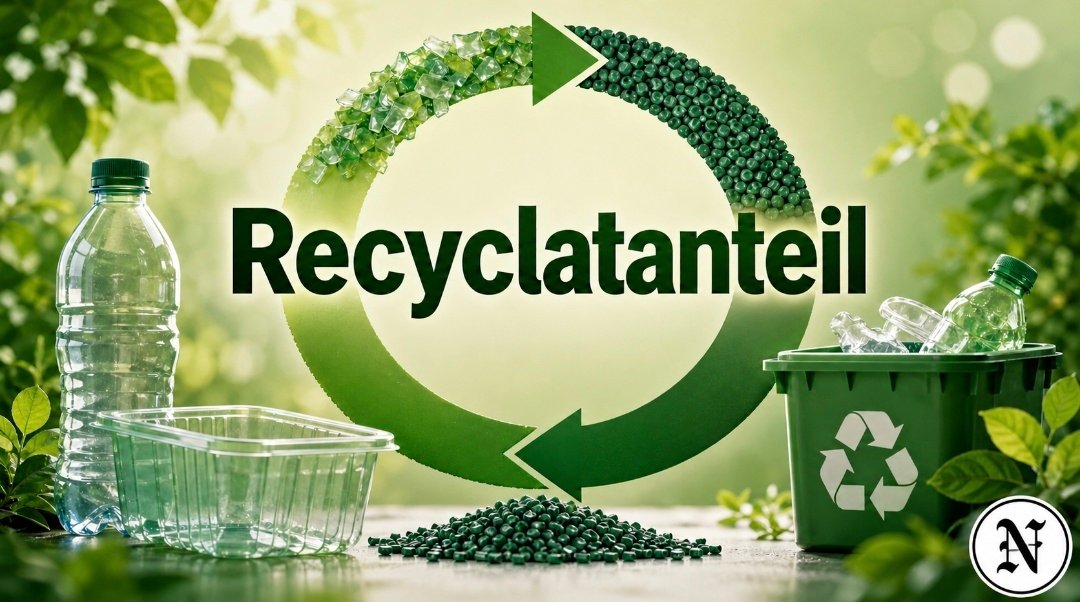
Most people think recycling ends when they toss something in the green bin. It does not. That moment is just the beginning of a long journey, and what happens next determines whether recycling creates any real value at all. Recyclatanteil is the metric that reveals the truth. It tells you whether recycled material actually made it back into a new product, not just whether it was collected and processed somewhere along the way.
I have spent considerable time studying how packaging companies, policymakers, and sustainability teams use this metric. What surprised me most was how often organizations report strong recycling performance while their actual use of recycled content stays embarrassingly low. Recyclatanteil exposes that gap. And in 2026, with new EU regulations tightening requirements across packaging categories, that gap is becoming harder to hide.
This article walks through everything you need to understand about recyclatanteil: what it really measures, how it differs from the recycling rate, how companies increase it, where regulations stand, and how to spot claims that are more marketing than substance.
What Is Recyclatanteil and Why Does the Definition Matter So Much?
Recyclatanteil is a German term that translates directly to recycled content share or recycled material proportion. It describes the percentage of recycled input material used in a finished product or packaging unit compared to its total weight.
READ MORE: What Is Adstotally.com? A Real Look at the Site and How Multi-Niche Blogs Can Succeed in 2026
If a plastic tray weighs 200 grams and contains 60 grams of recycled plastic, the recyclatanteil is 30 percent. That number is simple to understand but surprisingly difficult to verify in practice. The definition matters because not all recycled content is created equal. A claim of 40 percent recycled content can mean very different things depending on whether the material came from consumers discarding used products, or from factory floor offcuts that never left a production facility.
This is why recyclatanteil is more useful than vague sustainability language. It puts a number on something that would otherwise remain abstract. It forces specificity. And when paired with third-party verification, it gives buyers, regulators, and consumers an actual basis for comparison rather than a feeling.
Recyclatanteil vs Recycling Rate: A Distinction That Changes Everything
These two terms are frequently confused, and that confusion costs the circular economy real progress.
The recycling rate measures how much waste material enters a recycling system. It tracks collection, sorting, and processing volumes. A city, country, or company can have a high recycling rate simply by getting waste into the system efficiently. Germany consistently reports some of the highest recycling rates in the world, and that infrastructure genuinely matters.
But recyclatanteil measures something different. It measures how much recycled material was actually purchased and incorporated into new products. You can have excellent collection without any of that material finding its way back into production. When that happens, the recycling rate looks impressive on paper while the circular economy remains fundamentally broken in practice.
Think of it this way. The recycling rate counts what goes in. Recyclatanteil counts what comes back out and gets used again. One without the other tells an incomplete story. Both matter, but recyclatanteil is the closer measure of whether materials are genuinely staying in the economy rather than being downgraded, exported, or quietly landfilled after sorting.
Why Recyclatanteil Is Now Central to Circular Economy Strategy
The shift from voluntary sustainability commitments to binding regulatory requirements has made recyclatanteil a strategic necessity, not just a reporting metric.
Brands that once used recycled content as a marketing differentiator now face mandatory minimum thresholds under EU law. The Packaging and Packaging Waste Regulation, known as PPWR, is the most significant development here. It sets enforceable recycled content targets across plastic packaging categories and ties compliance to market access across EU member states. For manufacturers selling into European markets, recyclatanteil is no longer a nice-to-have. It is a compliance requirement with real commercial consequences.
Beyond compliance, there is a supply chain risk argument. Dependence on virgin petroleum-based plastics exposes companies to raw material price swings, geopolitical supply risks, and increasing carbon costs. Building recyclatanteil into sourcing strategy means reducing that exposure. Companies that have invested in verified recycled content supply chains consistently report stronger performance on both sustainability KPIs and long-term cost stability. That is not a coincidence. It reflects a genuine structural advantage that builds over time.
How Recyclatanteil Is Measured and Where the Real Challenges Sit
The calculation itself is straightforward. Divide the weight of recycled input material by the total weight of the product, then multiply by 100 to get a percentage. In controlled laboratory conditions, this is easy. In real production environments across global supply chains, it becomes significantly harder.
The actual challenge is traceability. To make a credible recyclatanteil claim, a company needs to know exactly where the recycled material came from, how it was collected and processed, what its purity levels are, and whether the documentation chain is strong enough to support an external audit. That level of supply chain transparency requires investment in systems, supplier relationships, and certification frameworks.
Standards like ISO 14021 define what constitutes a legitimate environmental claim for recycled content. Certification systems like RecyClass, developed specifically for packaging, allow producers to verify and communicate recyclatanteil in a way that is auditable and credible. Without these frameworks, a percentage printed on packaging can reflect anything from rigorous traceability to a rough internal estimate based on supplier assurances.
The companies that get this right tend to be the ones that started building traceability infrastructure before regulations forced them to. That early investment gives them faster compliance pathways, stronger supplier relationships, and more defensible claims when scrutiny increases.
PCR and PIR: Why the Source of Recycled Material Matters
Not all recycled content carries the same environmental or strategic value. The distinction between post-consumer recyclate and post-industrial recyclate shapes how recyclatanteil claims should be interpreted.
Post-consumer recyclate, or PCR, comes from materials that have been used by end consumers, collected through waste management systems, and processed back into usable feedstock. A PET bottle that was collected through a deposit return scheme, sorted, cleaned, and converted into recycled plastic granules is a clean example. PCR genuinely closes the loop. It takes material that would otherwise become waste and returns it to production.
Post-industrial recyclate, or PIR, comes from manufacturing processes. Factory offcuts, production scrap, and trimmings that never reached a consumer are collected and reused. PIR still reduces the need for virgin material, but it does not address the end-of-use waste stream that creates the most significant environmental and logistical challenges. Many manufacturing processes would recapture these materials anyway as part of standard efficiency practices.
For environmental credibility and circular economy impact, PCR carries more weight. For supply reliability and quality consistency, PIR is often easier to work with. In practice, most manufacturers use a combination of both. The key is transparency about which share comes from which source, because the environmental story behind each is quite different.
Where Recyclatanteil Appears in Products You Use Every Day
Recyclatanteil shows up most visibly in plastic packaging. Beverage bottles, household product containers, food trays, and personal care packaging are the categories where recycled content claims have become most common and most regulated. You have likely seen bottles labeled with claims about recycled plastic content. Those claims, when verifiable, represent measurable recyclatanteil.
Beyond packaging, recyclatanteil is present in textiles, particularly in polyester garments made from recycled PET bottles. It appears in construction materials including recycled content insulation, aggregate, and board products. It is embedded in certain paper and cardboard products where post-consumer fiber makes up a portion of the finished material. And it is increasingly visible in automotive components, electronics housings, and furniture where sustainability reporting requirements push manufacturers to document their use of secondary materials.
What makes this metric useful across all these categories is its consistency. Whether you are evaluating a food container or a car bumper, the recyclatanteil percentage gives you a comparable data point that works across materials and applications. That makes it a reliable building block for procurement standards, product labeling systems, and sustainability reporting frameworks.
How Businesses Actually Increase Their Recyclatanteil
Raising recyclatanteil is not primarily a purchasing decision. It starts with design.
Products designed with material simplicity tend to be easier to recycle and easier to reincorporate back into new products. Mono-material packaging, reduced colorants, compatible adhesives, and simplified multi-layer structures all improve both recyclability and the viability of using recycled content in future production cycles. This is sometimes called design for circularity, and it has a direct upstream effect on recyclatanteil potential.
On the sourcing side, building relationships with reliable recycled material suppliers takes time. Quality, consistency, and documentation all need to meet production standards before a manufacturer can increase recycled content without risking product failures. This is why scaling recyclatanteil tends to happen gradually rather than overnight. Companies that push too fast without verifying material quality end up with production problems that set back both their sustainability programs and their supplier relationships.
Testing plays a central role. Recycled materials can vary in mechanical properties, color, odor, and contamination risk depending on the input stream and processing quality. A thorough qualification process for each recycled feedstock is essential before production-scale adoption. The companies that build robust internal testing protocols for recycled inputs move faster and more confidently than those that rely entirely on supplier specifications.
EU Regulations Driving Recyclatanteil Requirements in 2026
The regulatory environment around recyclatanteil has shifted substantially in recent years and continues to tighten.
The PPWR, which entered application across EU member states with staggered timelines, sets binding minimum recycled content requirements for plastic packaging by category and phase. Specific targets apply to contact-sensitive packaging including food and beverage containers, with progressively higher percentages required by 2030 and 2040 milestones. These are not aspirational targets. Non-compliance affects market access.
The EU Single-Use Plastics Directive has accelerated recycled content requirements for specific product categories including beverage bottles, where minimum PCR thresholds apply. Beyond the EU, the UK Plastic Packaging Tax applies a financial charge to packaging containing less than 30 percent recycled content, creating a direct economic incentive to increase recyclatanteil. California’s AB 793 law establishes legally binding minimum recycled content levels for plastic bottles sold in that state.
Taken together, these frameworks mean that recyclatanteil is now a compliance variable in every major packaging market. Companies that have not yet built recycled content into their sourcing strategies are running out of time to catch up before the next set of regulatory deadlines arrives.
Mechanical vs Chemical Recycling and Their Effect on Recyclatanteil
The recycling technology used to produce secondary materials affects both their quality and their eligibility for recyclatanteil claims in specific applications.
Mechanical recycling remains the dominant and most cost-effective route for clean, well-sorted material streams. Sorting, shredding, washing, and melting produce recycled granules or flakes that can be reintroduced into production at significant scale. For PET bottles, HDPE containers, and many film materials, mechanical recycling delivers reliable recycled feedstock with a strong track record in both food and non-food applications.
Chemical recycling addresses material streams that are too contaminated, too mixed, or too degraded for mechanical processing. Pyrolysis, solvolysis, and depolymerization processes break polymers down to molecular components, producing outputs that in some cases match virgin material quality. This is particularly relevant for food-contact applications where safety requirements limit the use of mechanically recycled content.
The tradeoff is energy intensity and cost. Chemical recycling processes typically require more energy than mechanical alternatives, and the economics remain challenging at current scales. For mass-market packaging, mechanical recycling supports the bulk of recyclatanteil targets. Chemical recycling fills gaps where mechanical processing cannot deliver the quality needed, expanding the range of materials and applications where recycled content is technically feasible.
Greenwashing Red Flags: How to Spot Weak Recyclatanteil Claims
The word “recycled” on a product tells you almost nothing by itself. Strong recyclatanteil claims have specific characteristics. Weak ones share specific warning signs.
A credible claim includes a specific percentage. If a package says “contains recycled material” without a number, that is not a recyclatanteil claim. It is a marketing phrase. Similarly, a claim that confuses recyclability with recycled content is misleading by design. A package that is technically recyclable and contains no recycled material can legally use the word recyclable, but that says nothing about its recyclatanteil.
Trustworthy claims reference a certification or verification standard. ISO 14021, RecyClass certification, or chain-of-custody documentation from an accredited body all indicate that someone external has looked at the evidence. Claims without any verification are self-reported and provide no independent assurance.
Finally, clarity on material source matters. Knowing whether the recycled content is post-consumer or post-industrial tells you something meaningful about what kind of waste stream the product is helping to manage. A brand that voluntarily distinguishes between these sources and explains its verification approach is signaling a level of transparency that typically reflects genuine operational commitment rather than surface-level positioning.
READ MORE: Nionenad Explained: Meaning, Origins, and Why It’s Gaining Attention in 2026
Conclusion: Recyclatanteil as a Measure of Real Circular Economy Progress
Recyclatanteil is not a marketing metric. It is an operational one. It captures whether the circular economy is functioning at the production stage where it matters most. High recycling rates without corresponding recycled content use represent an incomplete system. Recyclatanteil closes that accountability gap.
For businesses, prioritizing recyclatanteil means aligning product design, sourcing strategy, and verification infrastructure with circular economy principles before regulatory pressure forces a faster and more expensive transition. For consumers, understanding recyclatanteil means being able to distinguish between genuine material reuse and vague sustainability language that substitutes impression for impact.
The metric will only become more important as regulations tighten, supply chains face increasing scrutiny, and markets reward companies that demonstrate credible, measurable environmental performance. Getting recyclatanteil right now is not just good sustainability practice. It is good business strategy.
Frequently Asked Questions About Recyclatanteil
1. Does a higher recyclatanteil always mean a more sustainable product?
Not automatically. Higher recycled content is generally positive, but sustainability depends on the full product lifecycle. A higher recyclatanteil from low-quality material with significant processing losses may not deliver the environmental benefit the number suggests. Context, material type, and verification quality all matter alongside the percentage itself.
2. Can a package be marketed as recyclable while having zero recyclatanteil?
Yes, and this happens regularly. Recyclability describes a product’s potential to enter a recycling system at end of life. Recyclatanteil describes what went into making the product. A package can carry both claims, one claim, or neither. They measure entirely different things and should never be used interchangeably.
3. Why do some food manufacturers have lower recyclatanteil than non-food brands?
Food contact regulations impose stricter safety requirements on recycled content. Post-consumer recycled plastic must meet food-grade safety standards, which limits the supply of eligible material and often requires more advanced processing technologies. That makes food-grade recyclatanteil targets harder and more expensive to achieve than targets in non-food applications.
4. How can a consumer or buyer verify a recyclatanteil claim?
Look for a specific percentage, a named certification or standard, and clear language about whether the material is post-consumer or post-industrial. If none of these elements are present, the claim offers no verifiable basis for trust. Third-party certifications like RecyClass provide the most reliable independent confirmation available for packaging-specific claims.
5. What happens to recyclatanteil targets if recycled material supply cannot meet demand?
Supply constraints are one of the most significant structural barriers to meeting regulatory targets. When demand for high-quality recycled material outpaces supply, prices rise and some manufacturers are unable to source enough eligible material to hit their targets. This is why policy discussions increasingly focus on improving collection infrastructure alongside setting content mandates, because mandates without sufficient material supply create compliance gaps that no company can close through purchasing decisions alone.
READ MORE: https://newsobuzz.com/
